








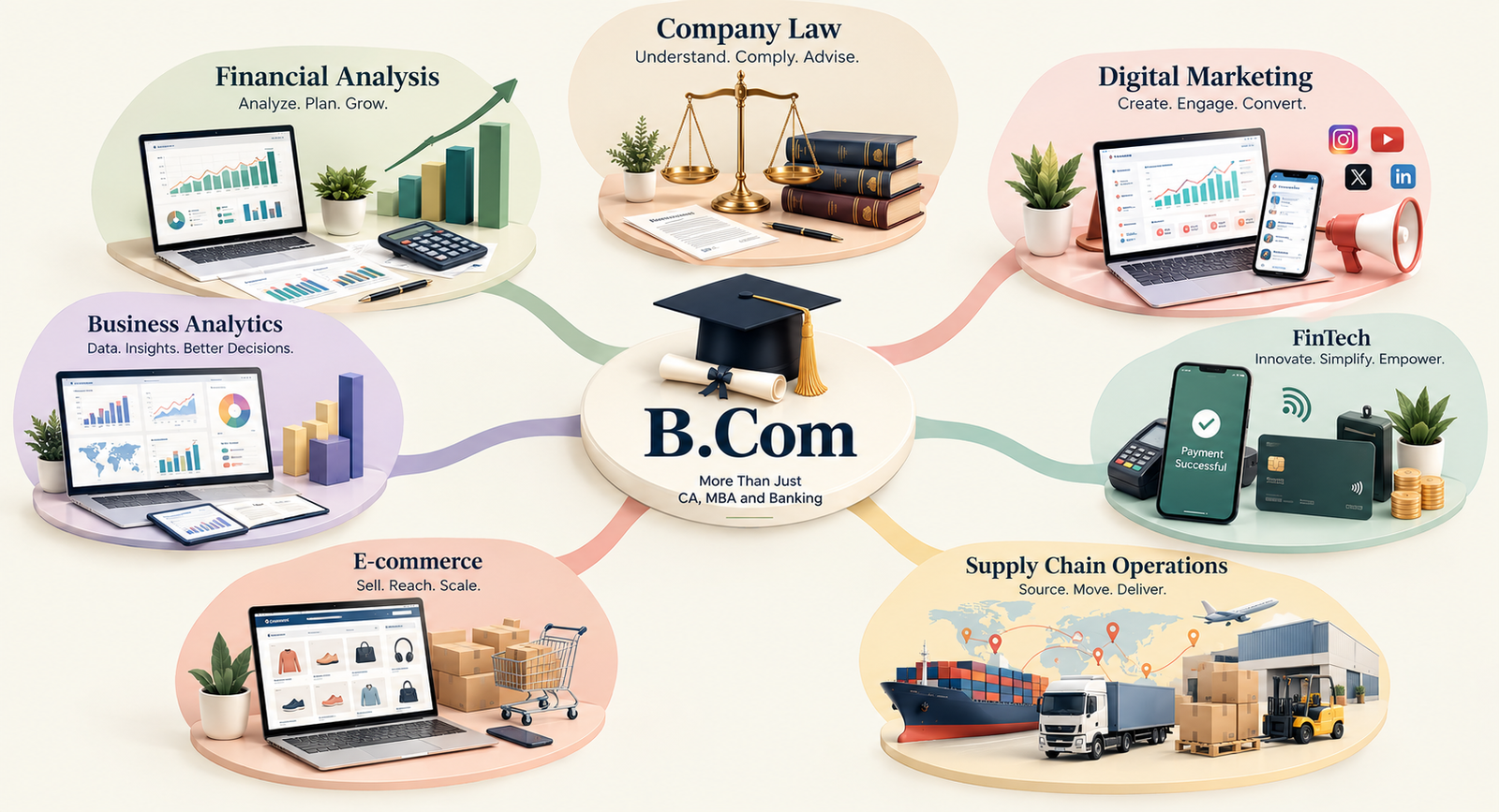
For many Commerce students, the usual career advice after B.Com sounds repetitive: do CA, pursue an MBA or prepare for banking exams.
But B.Com does not have to end with one of these three options.
A B.Com degree gives you a foundation in business, finance, accounting and economics. You can use that foundation to move into several specialised careers, especially if you add the right skills, certifications, internships and practical experience.
Here are some career paths worth exploring after B.Com.
1. Financial Analyst
If you enjoy numbers but don’t necessarily want to become an accountant, financial analysis can be an interesting direction.
Financial analysts study financial data, company performance, markets and business trends to support investment and business decisions.
You may work in:
- Financial analysis
- Corporate finance
- Investment research
- Business analysis
- Financial planning
Useful skills: Excel, financial modelling, accounting fundamentals, data analysis and financial markets.
2. Company Secretary
A B.Com graduate can explore the Company Secretary (CS) qualification through the Institute of Company Secretaries of India.
CS focuses more on company law, corporate compliance, governance and regulatory requirements than traditional accounting.
Career areas include:
- Corporate compliance
- Company law
- Governance
- Secretarial practice
- Regulatory work
This can suit students who enjoy business, law and regulations.
3. Cost and Management Accountant
Another option is CMA, which focuses on cost management, management accounting and financial decision-making.
Unlike a conventional accounting role, CMA can involve helping organisations understand costs, budgets, profitability and business performance.
Possible career areas:
- Cost accounting
- Management accounting
- Budgeting
- Cost control
- Financial planning
- Business analysis
4. Digital Marketing
A B.Com degree doesn’t mean you have to stay within traditional finance.
If you’re interested in marketing, social media, advertising and business growth, digital marketing can be a strong skill-based career direction.
You can build skills in:
- SEO
- Social media marketing
- Paid advertising
- Content marketing
- Email marketing
- Analytics
- E-commerce
A portfolio of actual campaigns or projects can be more useful than collecting certificates without practical experience.
5. Business Analyst
Business analysts help organisations understand problems, analyse information and improve business processes.
A Commerce background can provide useful knowledge of business operations, finance and organisational processes.
Skills to build:
- Excel
- Data analysis
- Power BI
- SQL basics
- Business communication
- Problem-solving
This can be a good option for students who enjoy business + data.
6. Financial Planning and Wealth Management
If you are interested in helping individuals manage their money, you can explore careers in financial planning and wealth management.
The work can involve areas such as:
- Investment planning
- Insurance planning
- Retirement planning
- Personal finance
- Wealth management
- Client relationship management
Professional financial-planning qualifications can also be explored depending on your intended role and eligibility.
This career can suit students who enjoy finance as well as communication and client interaction.
7. Actuarial Science
Actuarial careers combine mathematics, statistics, finance and risk analysis.
Actuaries work on areas such as insurance, investments, pensions and financial risk.
However, this is not an easy shortcut after B.Com. The professional qualification involves a demanding examination pathway, and students should be comfortable with mathematics and analytical problem-solving.
If you genuinely enjoy statistics, probability and numbers, it can be worth exploring.
8. Taxation and GST
Taxation is another specialised area where Commerce graduates can build careers.
You can develop knowledge of:
- Income tax
- GST
- Tax compliance
- Tax documentation
- Tax research
- Business taxation
Possible roles include tax associate, tax analyst and tax-compliance positions.
Specialised taxation courses and practical exposure can help you move beyond basic accounting work.
9. E-Commerce and Marketplace Management
The growth of online businesses has created roles that combine commerce, operations, marketing and technology.
You can work in areas such as:
- E-commerce operations
- Marketplace management
- Product listings
- Online sales
- Customer experience
- E-commerce marketing
- Order and inventory management
Platforms such as online marketplaces and direct-to-consumer businesses require people who understand both business and digital operations.
10. Supply Chain and Procurement
B.Com graduates can also explore careers in procurement, purchasing, logistics and supply-chain operations.
These roles involve managing suppliers, costs, inventory and business operations.
Possible roles:
- Procurement executive
- Purchase analyst
- Supply-chain coordinator
- Inventory analyst
- Operations executive
This can be a good fit if you enjoy business operations and problem-solving rather than purely financial work.
11. Sales and Business Development
Sales is sometimes overlooked by Commerce graduates because it doesn’t sound like a traditional “Commerce career.”
But business development and sales can offer strong opportunities for people who are good at communication, negotiation, relationship building and understanding customer needs.
You can work in:
- B2B sales
- Business development
- Account management
- Customer success
- Enterprise sales
Performance-based roles can also offer career progression as your experience grows.
12. Financial Technology (FinTech)
FinTech combines finance and technology, creating another direction for Commerce graduates.
You can explore roles related to:
- Digital payments
- Financial operations
- Risk
- Product operations
- Financial data
- Customer experience
- FinTech sales
Learning tools such as Excel, Power BI, SQL or basic data analytics can help you move towards more technology-oriented roles.
Which Career Should You Choose After B.Com?
There isn’t one “best” career for every B.Com graduate.
| If you enjoy… | Careers to explore |
|---|---|
| Numbers & analysis | Financial analyst, business analyst |
| Law & compliance | Company Secretary, taxation |
| Cost & finance | CMA, management accounting |
| Marketing | Digital marketing, e-commerce |
| Communication | Sales, business development |
| Finance & people | Financial planning, wealth management |
| Maths & statistics | Actuarial science |
| Operations | Supply chain, procurement |
| Finance + technology | FinTech |
Your B.Com Degree Is Only the Starting Point
One of the biggest mistakes B.Com graduates make is assuming that the degree itself will determine their career.
It won’t.
The same B.Com degree can lead to very different careers depending on what you build alongside it.
For example:
B.Com + Excel + Power BI + analytics → Business Analyst
B.Com + marketing skills + portfolio → Digital Marketing
B.Com + CS qualification → Corporate Compliance
B.Com + financial modelling → Financial Analysis
B.Com + e-commerce skills → E-commerce Operations
The combination of your degree + specialised skills + practical experience is what makes your profile stronger.
Final Thoughts
CA, MBA and banking are popular choices after B.Com, but they are far from the only ones.
You can explore financial analysis, company secretarial work, CMA, taxation, digital marketing, business analysis, financial planning, actuarial science, e-commerce, supply chain, sales and FinTech.
The right choice depends on what you are good at, what type of work you enjoy and which skills you are willing to develop.
Instead of asking, “What should every B.Com graduate do?”, ask:
“What career can I build with my Commerce knowledge and the skills I actually enjoy using?”
That question can open up far more possibilities.