








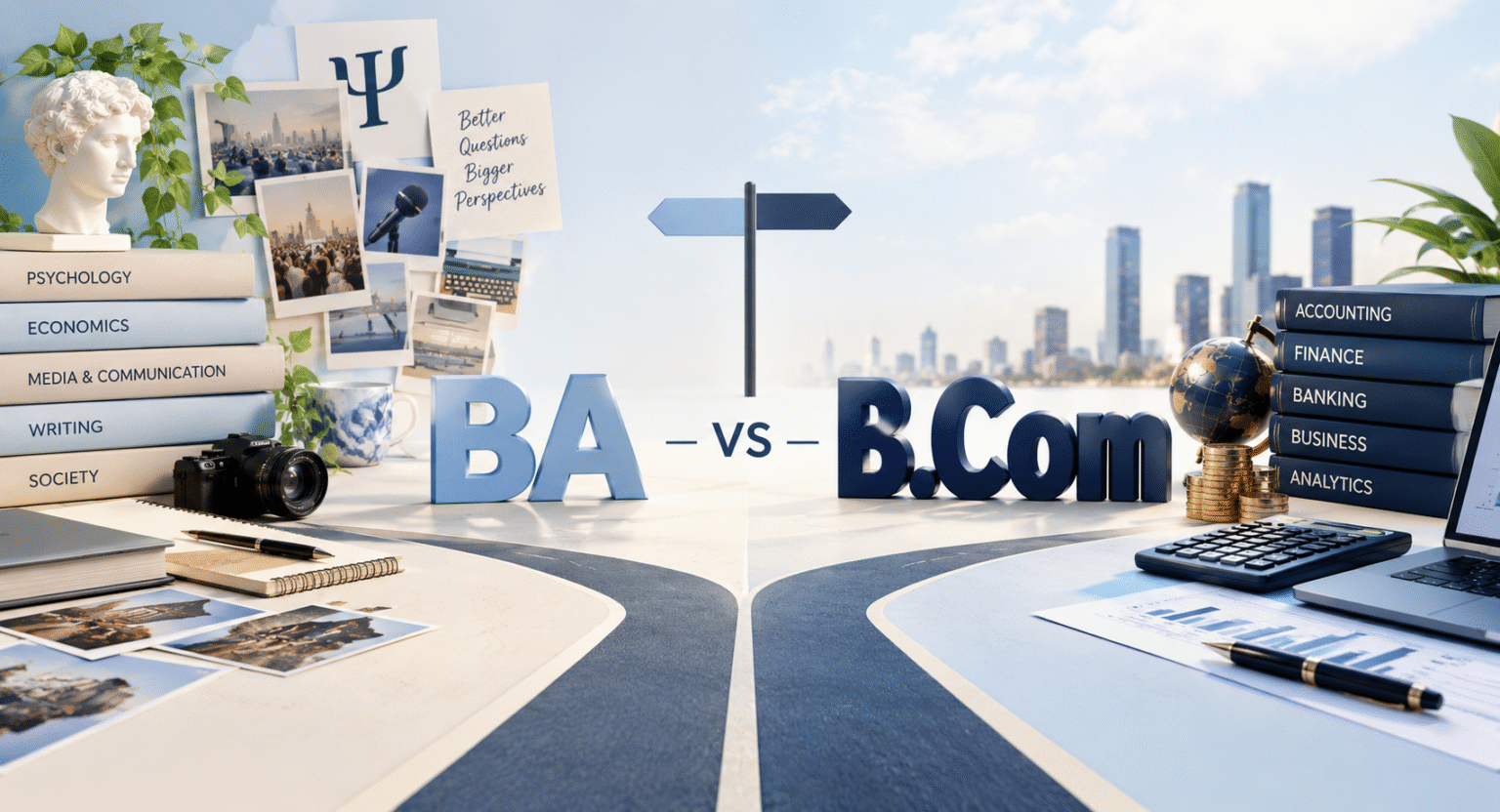
After Class 12, students often compare BA (Bachelor of Arts) and B.Com (Bachelor of Commerce). Both are undergraduate degrees, but they lead students towards different subjects, skills and career directions.
B.Com is usually associated with commerce, finance and business, while BA offers a much broader range of subjects such as economics, psychology, sociology, political science, English, history and other humanities disciplines.
So, which degree gives you better career options?
The answer depends on what you want to study, the skills you want to develop and the career you plan to build after graduation.
What Is B.Com?
B.Com stands for Bachelor of Commerce.
It is designed around areas related to commerce, accounting, finance, taxation, economics and business. Depending on the university, students may also have options to specialise in areas such as banking, finance, accounting, taxation or business analytics.
Common B.Com subjects
- Financial accounting
- Business economics
- Business law
- Cost accounting
- Taxation
- Financial management
- Marketing
- Business communication
- Auditing
B.Com can be particularly relevant for students who are comfortable with numbers, business and financial concepts.
What Is BA?
BA stands for Bachelor of Arts.
Unlike B.Com, BA covers a much wider range of disciplines. The subjects available depend heavily on the university and programme.
Common BA subjects
- Economics
- Psychology
- English
- Sociology
- Political science
- History
- Geography
- Journalism
- Public administration
BA can suit students who are interested in people, society, communication, creativity, research, economics or public affairs.
BA vs B.Com: Key Differences
| Factor | BA | B.Com |
|---|---|---|
| Main focus | Arts, humanities and social sciences | Commerce, finance and business |
| Subjects | Psychology, economics, English, sociology, history, etc. | Accounting, finance, taxation, economics, business, etc. |
| Suitable for | Students interested in people, society, communication, creativity or humanities | Students interested in business, finance, accounting and commerce |
| Career areas | Media, psychology, education, research, public sector, content, communication | Finance, accounting, banking, taxation, business, sales |
| Further study | MA, MBA, professional courses, specialised programmes | M.Com, MBA, professional qualifications, specialised programmes |
| Skill emphasis | Communication, research, analysis, subject expertise | Financial understanding, business knowledge, numerical and analytical skills |
Career Options After B.Com
A B.Com degree can provide a foundation for careers in several business and finance-related areas.
1. Accounting and Finance
You can explore roles such as:
- Accounts executive
- Finance executive
- Financial operations associate
- Tax assistant
- Audit associate
Students interested in professional qualifications can also explore pathways such as CA, CMA, CS, ACCA and other specialised qualifications, depending on eligibility.
2. Banking and Financial Services
B.Com graduates can explore areas such as:
- Banking operations
- Credit
- Financial services
- Insurance
- Investment services
- Customer relationship roles
Additional certifications and practical skills can help build specialisation.
3. Business and Management
B.Com graduates can also move towards:
- Sales
- Marketing
- Business development
- Operations
- Human resources
- Entrepreneurship
An MBA is another possible route for students who want to move towards management.
Career Options After BA
BA can lead to a wide variety of careers depending on the subject you choose and the skills you build.
1. Media and Communication
Students interested in communication can explore:
- Content writing
- Journalism
- Public relations
- Social media
- Copywriting
- Digital content
Practical experience and a portfolio can be particularly useful in these fields.
2. Psychology and People-Focused Careers
A BA with psychology can provide a foundation for further study in psychology and related areas.
Students should remember that some psychology-related professional roles require additional qualifications, so the career requirements should be checked before choosing a particular path.
3. Economics and Research
Students studying economics can explore:
- Research
- Data-oriented roles
- Business analysis
- Economic research
- Policy-related work
Additional quantitative and analytical skills can expand these options.
4. Government and Competitive Examinations
BA graduates can also prepare for various competitive examinations and public-sector career pathways where their eligibility meets the relevant requirements.
The degree itself does not guarantee a government job; examination preparation and eligibility requirements still matter.
BA vs B.Com: Which Has More Career Options?
It is difficult to say that one degree automatically provides more career options.
B.Com is more directly aligned with commerce, finance, accounting and business, while BA can open pathways across humanities, social sciences, communication, economics and related fields.
Your subject choice can also make a major difference.
For example:
BA Economics and BA Psychology can lead towards very different career directions.
Similarly, general B.Com, B.Com Finance and B.Com with specialised subjects can provide different learning experiences.
Which Degree Should You Choose?
Think about the type of work you would enjoy.
Choose B.Com if you are interested in:
- Accounting
- Finance
- Banking
- Business
- Taxation
- Corporate work
- Numbers and financial analysis
Consider BA if you are interested in:
- Psychology
- Communication
- Writing
- Media
- Economics
- Society and human behaviour
- Research
- Humanities
- Public affairs
You should also consider whether you want to pursue professional qualifications, postgraduate study or a skill-based career after graduation.
Don’t Choose Only by Career Salary
A common mistake is choosing a degree because someone says it has “better scope.”
Career outcomes depend on several factors, including:
- Your chosen subject
- College and curriculum
- Skills
- Internships
- Communication ability
- Practical experience
- Professional qualifications
- Further education
- The specific career you enter
A B.Com student without practical skills may struggle to stand out, just as a BA graduate without relevant skills or experience may find some career paths more difficult.
The degree is the starting point—not the entire career.
BA vs B.Com: A Simple Decision Framework
Ask yourself these three questions:
1. What subjects do I genuinely enjoy?
Would you rather study accounting and finance or psychology, economics, communication and society?
2. What kind of work interests you?
Do you imagine yourself working with financial information and businesses, or with people, communication, research or creative work?
3. What do you want to do after graduation?
Look at the qualification requirements for your target career before selecting your degree.
Final Thoughts
BA and B.Com are both useful undergraduate pathways, but they serve different interests.
B.Com can provide a stronger foundation for students interested in commerce, finance, accounting and business. BA offers broader possibilities across humanities, social sciences, communication, economics and related fields.
There is no single degree that is automatically better for everyone.
Instead of asking “BA or B.Com—which is better?”, ask:
“Which degree gives me the subjects, skills and pathway that fit the career I want?”
That question can lead to a much better career decision.