








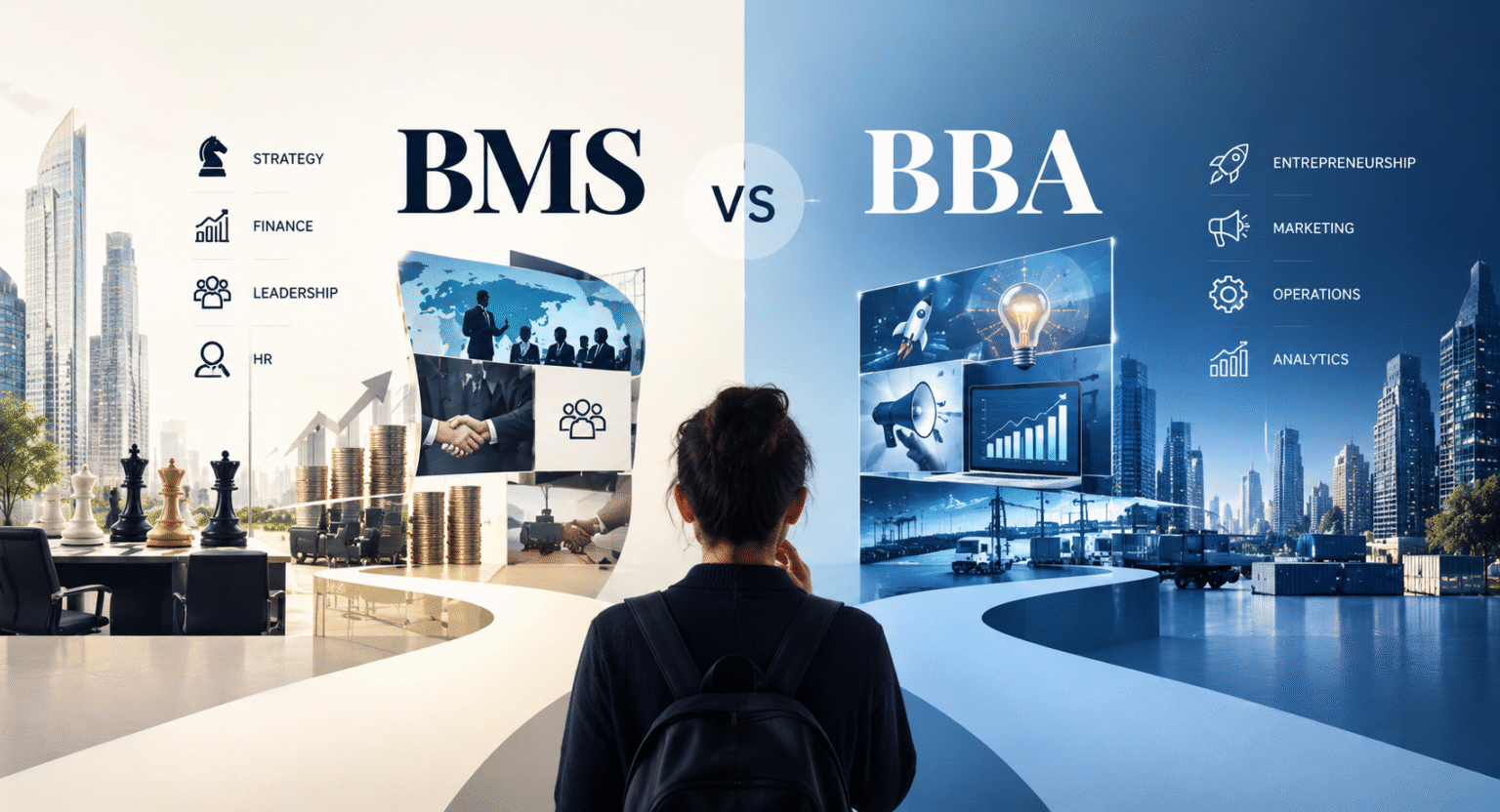
After Class 12 Commerce, students often come across two similar-looking options: BMS (Bachelor of Management Studies) and BBA (Bachelor of Business Administration).
Both are undergraduate management degrees, and both can lead towards careers in areas such as marketing, finance, human resources, sales, operations and entrepreneurship. But their course structures, college offerings and areas of emphasis can differ.
So, what is the actual difference between BMS and BBA? And which one should you choose?
The answer depends less on the name of the degree and more on what you want to learn and where you want your career to go.
What Is BMS?
BMS stands for Bachelor of Management Studies.
It is an undergraduate management programme that focuses on understanding how organisations work, how businesses make decisions and how different management functions operate.
For example, the University of Mumbai’s BMS curriculum includes subjects such as strategic management, business planning, accounting for managerial decisions and information technology in business management. Its curriculum also includes electives in areas such as finance, marketing and human resources.
BMS is therefore particularly relevant for students interested in management, business strategy and specialised business functions.
What Is BBA?
BBA stands for Bachelor of Business Administration.
BBA is also an undergraduate business and management degree. Depending on the university and college, BBA programmes can offer different specialisations such as finance, marketing, human resources, international business, business analytics or entrepreneurship.
The exact syllabus can vary considerably between institutions, so students should always check the curriculum of the specific college rather than assuming every BBA is the same.
BMS vs BBA: Key Differences
| Factor | BMS | BBA |
|---|---|---|
| Full form | Bachelor of Management Studies | Bachelor of Business Administration |
| Main focus | Management and organisational studies | Business administration and management |
| Curriculum | Often management-focused with specialised electives | Varies significantly by university |
| Common areas | Finance, marketing, HR, strategy | Finance, marketing, HR, operations, entrepreneurship |
| Duration | Commonly 3–4 years depending on university structure | Commonly 3–4 years depending on university structure |
| Career direction | Management, finance, marketing, HR, business roles | Business, management, marketing, finance, entrepreneurship |
| Further study | MBA/MMS and other specialised programmes | MBA/MMS and other specialised programmes |
Under India’s current undergraduate framework, programme structures can also include multiple entry and exit options and greater flexibility in choosing subjects, so the duration and structure may differ between institutions.
BMS vs BBA: What Will You Study?
The biggest difference is often not the degree title but the actual syllabus offered by the college.
In BMS, you may study:
- Strategic management
- Business planning
- Managerial accounting
- Marketing
- Human resource management
- Finance
- Business technology
- Entrepreneurship
- Operations
For example, Mumbai University’s BMS structure has separate elective groups for finance, marketing and HR.
In BBA, you may study:
- Principles of management
- Business economics
- Marketing
- Finance
- Human resources
- Business communication
- Operations
- Entrepreneurship
- Business analytics
However, BBA curricula differ substantially across universities.
What Careers Can You Pursue After BMS or BBA?
Both degrees can provide a foundation for a wide range of entry-level business careers.
After BMS
Possible areas include:
- Marketing
- Finance
- Human resources
- Sales
- Operations
- Business development
- Management
- Entrepreneurship
After BBA
Possible areas include:
- Marketing
- Sales
- Finance
- HR
- Operations
- Business development
- Digital business
- Entrepreneurship
Your actual career options will depend on your skills, internships, college exposure, specialisation and work experience, not just the degree name.
BMS or BBA for MBA?
Both BMS and BBA can be followed by an MBA or MMS.
If you already know that you want to move into management, completing a bachelor’s degree and then pursuing postgraduate management education can be one possible route.
But you don’t necessarily have to wait until your postgraduate degree to develop career skills. Internships, projects, presentations, Excel, analytics, communication, sales and digital tools can make your undergraduate years more practical.
Which Is Better: BMS or BBA?
There is no universal “better” option.
A student interested in management and specialised business functions may prefer a BMS programme with strong electives in areas they want to explore.
Another student may prefer a BBA programme because a particular college offers a useful specialisation, industry exposure, internship opportunities or a curriculum that matches their interests.
That is why comparing college + syllabus + opportunities is often more useful than comparing only BMS vs BBA.
What Should You Check Before Choosing?
Before applying, compare these five things:
1. Syllabus
Look beyond the course name. Check the actual subjects and electives.
2. Specialisations
If you already like finance, marketing, HR or analytics, see whether the programme provides relevant options.
3. Internships and practical exposure
Look for opportunities to work on projects and gain real-world experience.
4. College and faculty
The same degree can provide a very different experience depending on the institution.
5. Your career direction
Think about whether you want to move towards marketing, finance, HR, entrepreneurship, analytics or general management.
BMS vs BBA: The Simple Way to Decide
If you’re confused, don’t ask only:
“Is BMS better than BBA?”
Instead ask:
“Which programme gives me the subjects, exposure and skills that match the career I want?”
For example:
- Interested in finance? Compare finance subjects and electives.
- Interested in marketing? Check marketing, branding and digital-business exposure.
- Interested in HR? Look at HR and organisational behaviour subjects.
- Interested in entrepreneurship? Look for business planning and entrepreneurship opportunities.
- Not sure yet? Choose a programme with broader exposure and opportunities to explore different areas.
Final Thoughts
BMS and BBA are both management-oriented undergraduate degrees, but the actual curriculum can differ from one university to another.
BMS may have a stronger management-studies orientation in some universities, while BBA programmes can offer different business-focused structures and specialisations.
Instead of choosing based on the degree name alone, compare the syllabus, specialisations, college, internships, practical exposure and your own career interests.
Your degree gives you the foundation. The skills and experience you build alongside it can shape where that foundation takes you.